
Lawrence County Arrest Log Sources
Start with the sheriff's own tools. The official inmate roster lists everyone currently held. Its alphabetical cards say nothing about last week's bookings, so recent arrests need another trail. For announcements, the press-release page carries the office's releases, and it displays none at present. The county publishes no multi-day blotter of its own.
That leaves private reporting. Quad Cities Daily's Law & Order coverage comes closest. It is the nearest thing to a recurring Lawrence County arrest series. Each post covers a stated date range and credits booking photos to the sheriff. Treat it as selective reporting, though. It is not an official daily, weekly, or 72-hour window on county arrests.
Read Lawrence Arrest Reports Carefully
Check the outlet behind each Lawrence arrest report. Note the publication date too. Also separate the stated coverage range, the arresting agency, and the underlying source. That discipline keeps a late repost from reading as a false arrest date.
- Start with the official roster for present county custody. A match does not by itself place the arrest within the report's range.
- Open the original dated report, not a search snippet or copied summary. Record both the post date and the dates named in its title.
- Read each entry's booking date and arresting agency. Different police departments and outside agencies may appear together.
- Follow later case activity through Search ARCourts. A disposition is the court's resolution, not the original booking charge.
- For a same-day question, switch to 24 Hour Arrests and use its official custody fallback.
The August 9–28 report illustrates the dated-range format.
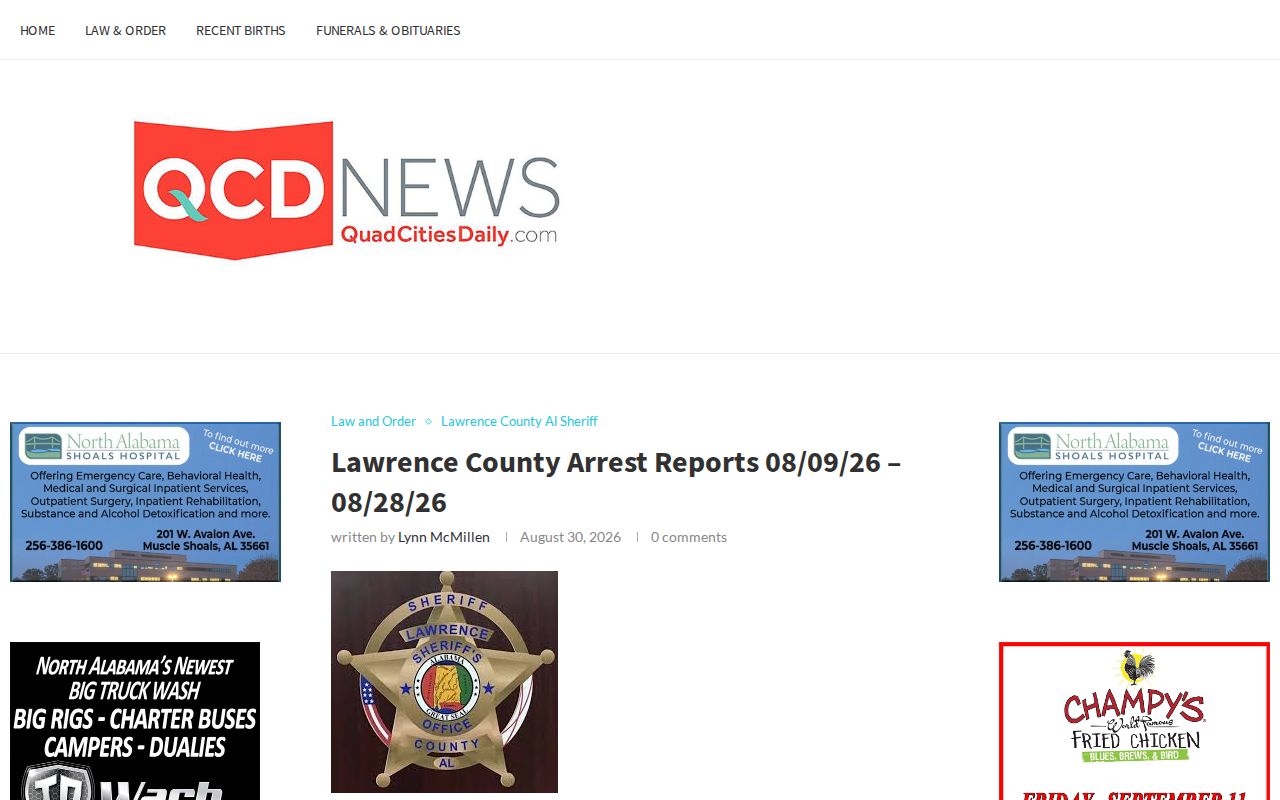
The image shows a private report format in context. It is not a gallery. Nor is it a stand-in for the official record. Treat it as context only.
Lawrence Arrest Report Fields
Quad Cities Daily entries carry richer narrative detail than the county's roster cards. Names, circumstances, and charges often get fuller treatment. Remember where that detail comes from, though: a secondary publisher. Any material point deserves a check against the originating agency's record. Make that check before you rely on it.
| Report field | Meaning and limit |
|---|---|
| Displayed name | The person identified in the report; confirm identity independently. |
| Arresting agency | The agency credited with the action, which may not be the sheriff. |
| Booking date/time | The reported processing time, distinct from publication time. |
| Charge description | An charge at booking. |
| Bond amount | A stated release condition, not a case outcome. |
| Booking photograph | An image credited to the sheriff; its presence proves neither current custody nor guilt. |
Two gaps catch people off guard. A report can linger online. It stays up long after the person has been released. And an arrest can happen without ever making an outlet's selections at all. The Lawrence County recent arrest hub lets you compare the record channels side by side.
Lawrence Arrest Posting Gaps
The unofficial reports follow no schedule. There is no weekend, holiday, publication, or roll-off pattern to lean on. Never assume a Monday post captured every weekend arrest. The dated examples show that plainly. They spanned February 17 through 27, April 23 through May 13, and August 9 through 28, 2026. One range drifted near its endpoint, and another skipped days inside its own heading.
Posting lag is normal in narrative news. An outlet may wait on an affidavit, an agency statement, or court paperwork before running a story. Publication can trail the arrest by days. Holidays can slow office processing too, but no Lawrence source supports a precise delay claim. If timing matters, call the sheriff at (870) 886-2525. You can also ask the arresting agency for the underlying record.
The Imboden Live sheriff tag works differently. It runs story-based Lawrence County coverage rather than a dated booking series.
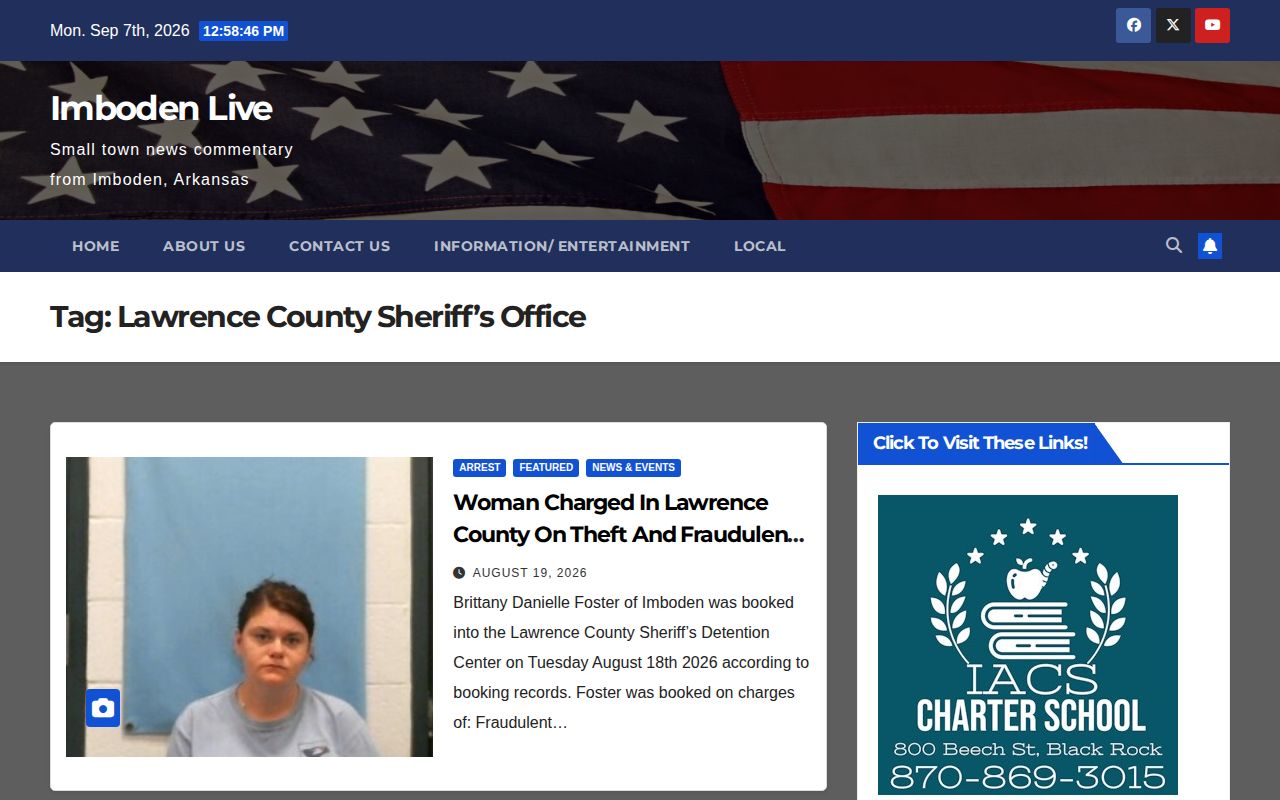
The tag mixes individual arrests with warrants, investigations, and court-linked stories. It is no booking ledger. Expect news items. A jail roster it is not.
Older Lawrence Arrest Records
Older material needs a different kind of care. Tag pagination counts articles, never arrests. Imboden Live's county tag runs deep into a mixed-news archive. Quad Cities Daily keeps its content in individual range posts. Neither depth tells you how many people were actually booked or how far any official log reaches. When you use an old story, save the original link, post date, headline range, and source credit.
For the record itself, send a focused Arkansas FOIA request to the Lawrence County Sheriff's Office. The address is 501 West Elm, Walnut Ridge, AR 72476. Include the name, approximate dates, and the agency. Add an incident or booking number if you know it, plus the specific fields you need. The sheriff site lists (870) 886-2525 and fax (870) 886-2922. It offers no records form, fee schedule, or promised turnaround.
Arkansas law treats booking records, detention logs, and booking photographs as retained records. A 30-year period applies before authorized disposal. Retention does not mean online access, though. A record can be sealed, redacted, transferred, or lawfully disposed of. For older newspaper context, the Northeast Arkansas Regional Archives and Arkansas State Archives are stronger leads. Any current arrest-report site falls short of them.
Multi-Agency Lawrence Arrest News
Coverage in this county comes from many hands. Imboden Live blends public-safety stories with accidents, notices, and community news. NEA Report often leans on a probable-cause affidavit. E Communications Network runs occasional event reports. NorthArkNow sometimes republishes another outlet's work, and KAIT8's historical reports can track incidents crossing Walnut Ridge, Ravenden, Imboden, Hoxie, and state-agency lines. None of them is a complete official log.
Read with the same discipline as before. Keep "according to" language where a story uses agency material, and never assume the city in a headline made the arrest. The arresting-agency field controls that question. The KAIT8 Lawrence County report shows the narrative, multi-jurisdiction format in action.
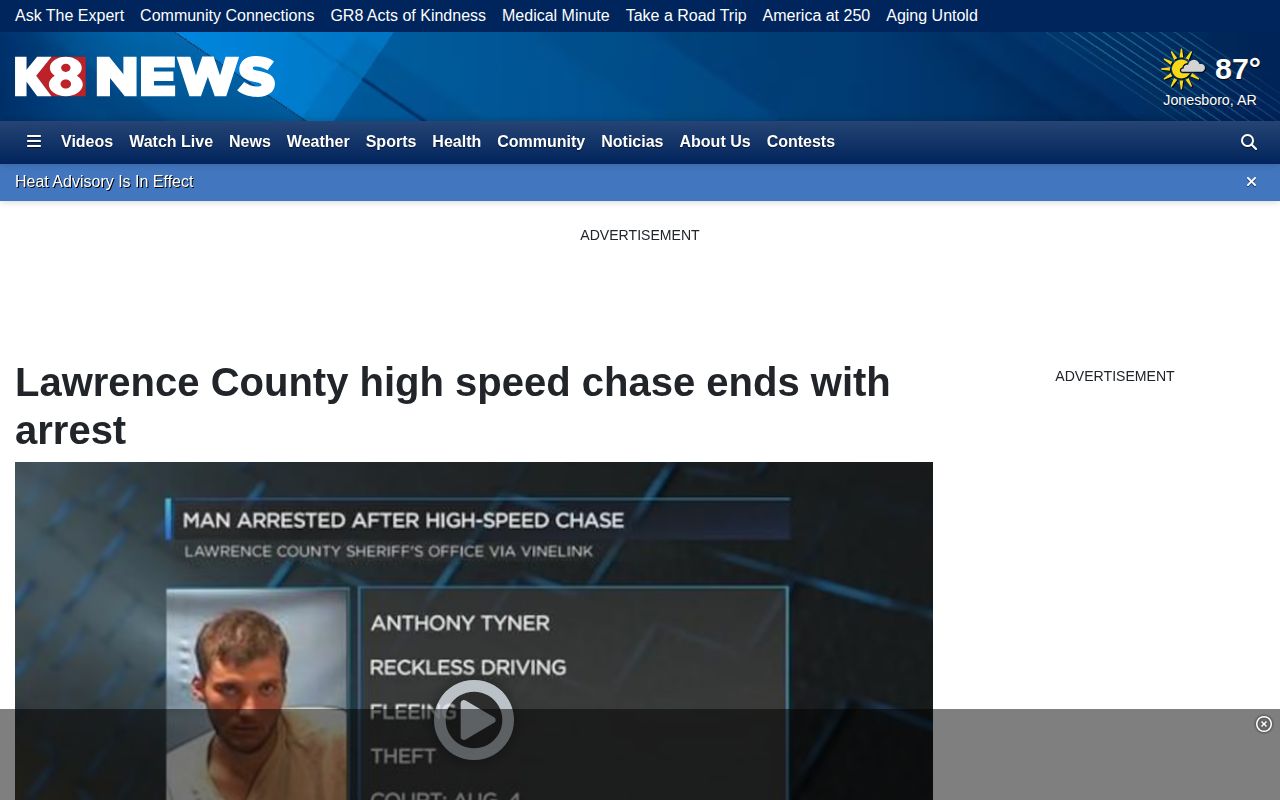
A story like that adds valuable context. Keep it separate from a current roster entry and from the later court result, and each piece stays useful.
Publication patterns and archive links change over time.
Trace Lawrence Arrest History
A news story and an official booking record serve different masters. One summarizes events. The other sits with a public custodian. For an older Lawrence County arrest, a focused Arkansas FOIA request to the arresting agency or the jail is the right tool. Name the person, give a date range and place, add any case or booking number, and state exactly which record you want.
Arkansas sheriff-retention law treats booking photographs and detention logs as jail booking records with a 30-year retention period. Retention is not the same as access. A record can be sealed, confidential, transferred, or lawfully destroyed. Ask the sheriff whether the item is still in county custody or has moved to an archive.
Deep local history starts at the Northeast Arkansas Regional Archives digital collection. NEARA serves Lawrence County and holds government materials, newspapers, photographs, maps, and more. Not everything is online, though. A newspaper backfile may describe an arrest or trial while never holding the original booking sheet. Search the event date first. Then try terms like dismissed, acquitted, pleaded, sentenced, or sealed.
Local news coverage calls for the same discipline. Imboden Live runs county, sheriff, and Hoxie tags. NEA Report favors long event narratives and sometimes posts probable-cause affidavits. E Communications Network and KAIT8 publish occasional arrest stories. NorthArkNow may cite or republish another outlet. The Times Dispatch is a Lawrence County newspaper lead, though it offers no continuous public arrest feed. Treat none of them as a county ledger.
A source note for each item pays off. Record the outlet, direct URL, publication date, the date range in the headline, the booking date in the entry, the arresting agency, and when you checked the page. That method exposes late publication and derivative reporting. It also stops an old, highly ranked story from masquerading as a current Lawrence County arrest.
Follow the credit when an article cites another outlet, an affidavit, or a sheriff record. An affidavit states facts offered to support legal process. The official court docket shows filed charges and hearings. A clerk's order supplies the final disposition. Keep those stages distinct in any multi-day timeline.